
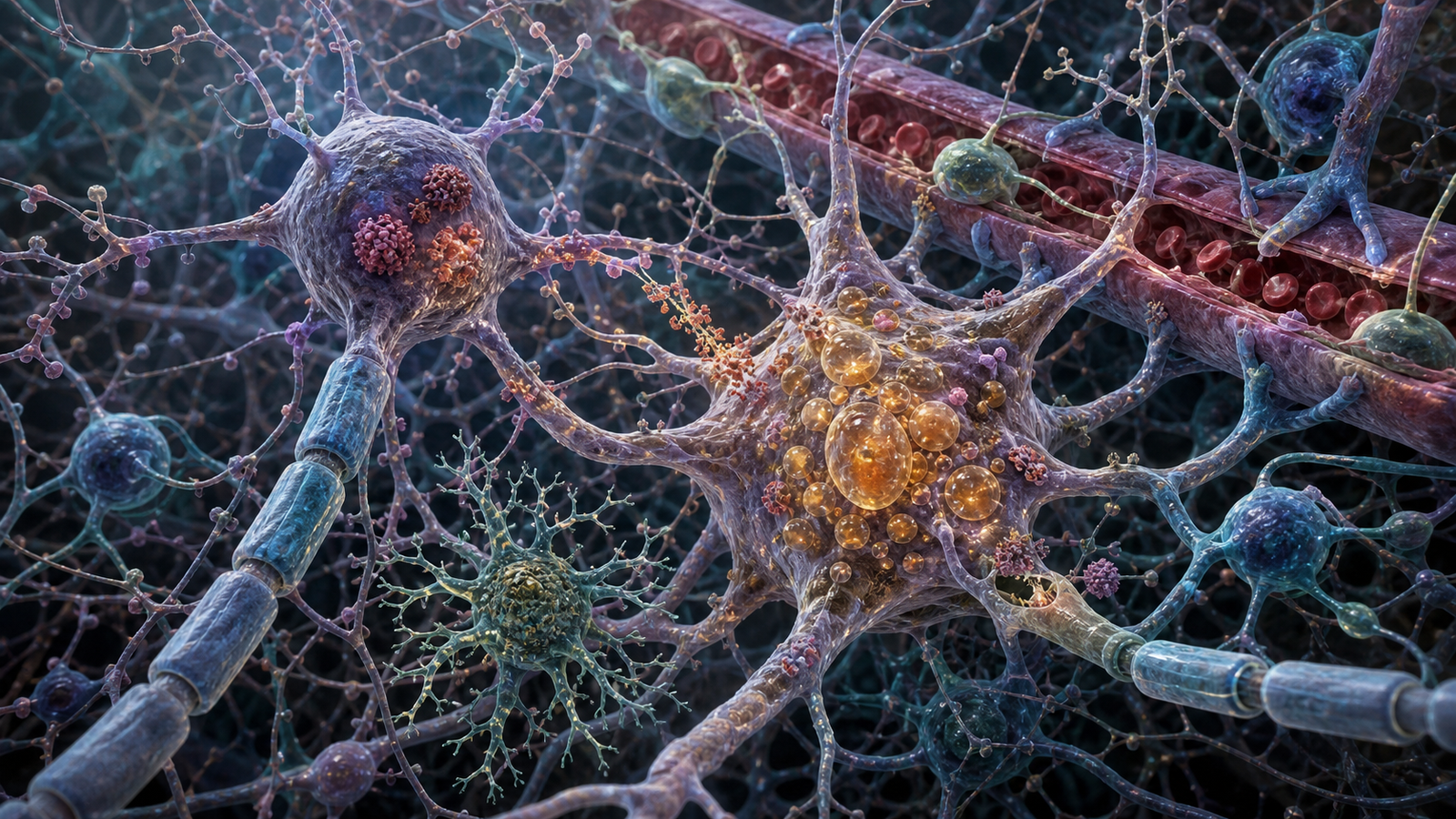
Editorial illustration of a multicellular miBrain experiment, with an APOE4 astrocyte at the center of cholesterol, lysosome, and alpha-synuclein handling. Credit: CellXperience generated editorial illustration.
An APOE4 astrocyte should not be able to hide inside this experiment. The researchers built human brain-like tissue from six separately differentiated iPSC-derived cell populations, then changed the APOE genotype of one population at a time. When APOE4 astrocytes were placed among APOE3 neurons, microglia, oligodendrocyte progenitors, endothelial cells, and mural cells, neuronal alpha-synuclein pathology rose to the level seen in tissue made entirely from APOE4 cells.
That result places astrocytes near the beginning of the mechanism modeled here. It also gives the study a sharper purpose than another report that APOE4 tissue behaves differently. The question is no longer only whether genotype matters. It becomes which cell carries enough of that genotype effect to damage its neighbors, and how.
Primary sources
- Cell Stem Cell, "Cholesterol dysregulation in APOE4 astrocytes promotes alpha-synuclein pathology in miBrains"
- Complete earlier manuscript in PubMed Central - https://pmc.ncbi.nlm.nih.gov/articles/PMC11839026/
Six cell populations in one engineered tissue
The model is called miBrain, short for multicellular integrated brain. Neurons provide the electrically active tissue. Astrocytes handle metabolic and extracellular support. Microglia supply resident immune functions. Oligodendrocyte progenitor cells contribute a myelinating lineage, while brain microvascular endothelial cells and mural cells add elements of the vascular compartment.
Each population was differentiated separately from human iPSCs and assembled into a small 3D tissue. Single-nucleus RNA sequencing confirmed that the expected cellular identities persisted after assembly and allowed the authors to examine how each population responded to alpha-synuclein pathology.
MiBrain is not a miniature adult brain. It has no circulation, long-range anatomy, peripheral immune system, or decades of aging. Its advantage comes from construction. The investigators can freeze large cell batches, combine defined populations, and reproduce an experiment in which a particular genotype belongs to a particular cell type.
The alpha-synuclein system is equally deliberate. Neurons expressed the A53T form of SNCA, a familial disease mutation, and some experiments used alpha-synuclein preformed fibrils to promote inclusion formation. The resulting phosphorylated alpha-synuclein offers a measurable pathology, but it arrives under conditions designed to make aggregation happen. Spontaneous Parkinson disease, Lewy body dementia, or Alzheimer disease may not begin the same way.
The astrocyte swap changes the tissue
APOE comes in several common forms. APOE4 raises the risk and often influences the severity of several neurodegenerative pathologies, but a human brain sample rarely reveals which cell type started a damaging interaction. Neurons, glia, and vascular cells carry the same inherited variant and change together as disease develops.
The authors avoided that entanglement with isogenic APOE3/3 and APOE4/4 iPSC lines. They assembled all-APOE3 and all-APOE4 miBrains, then made mixed tissues in which only one cell population carried APOE4.
Changing the neurons alone did not recreate the high phosphorylated alpha-synuclein burden. Neither did changing endothelial cells, mural cells, oligodendrocyte progenitors, or the other tested populations individually. APOE4 astrocytes did. In otherwise APOE3 tissue, their presence was sufficient to raise neuronal pathology to the all-APOE4 condition.
The single-population swap is unusually informative. APOE4 astrocytes carried enough of the genotype effect to reproduce the higher neuronal pathology without changing the other five cell populations. That makes the result harder to dismiss as a broad association between APOE4 tissue and alpha-synuclein.
It remains specific to the model. The result says that APOE4 astrocytes are sufficient to intensify induced alpha-synuclein pathology under these conditions. It does not establish that astrocytes always initiate human synucleinopathy, nor does it exclude important roles for microglia, neurons, vascular cells, or aging in patients.
Cholesterol accumulates where alpha-synuclein should be degraded
The next experiments followed soluble alpha-synuclein into astrocytes. APOE3 astrocytes took up the protein and routed more of it through an acidic, proteolytically active lysosomal system. APOE4 astrocytes internalized alpha-synuclein but degraded it less effectively.
Their lysosomes were less acidic and showed weaker proteolysis. Cholesterol accumulated in the cells and in lysosomal compartments, connecting a well-known feature of APOE biology with the failure of intracellular waste processing.
Poor degradation alone would leave more alpha-synuclein inside astrocytes. The more consequential observation came after release. Material recovered from APOE4 astrocyte cultures was more capable of producing phosphorylated alpha-synuclein inclusions in neurons. An astrocyte intended to clear extracellular protein had become a source of seeding activity.
This sequence gives the paper its mechanistic shape. APOE4 alters cholesterol handling in astrocytes. Cholesterol-rich lysosomes lose part of their degradative capacity. Soluble alpha-synuclein survives processing and returns to the surrounding tissue in a more pathogenic form. Neurons then accumulate inclusions.
Several links in that chain were measured with different assays, but the model cannot show that it unfolds in precisely this order over years in a human brain. Alpha-synuclein exposure is compressed into laboratory time, and the A53T plus fibril system creates a strong aggregation pressure. The study provides a testable route, not a clinical chronology.
Changing cholesterol changes the modeled pathology
The authors next asked whether cholesterol was merely associated with the APOE4 state or functionally involved in it. They tested compounds that alter cholesterol abundance, trafficking, synthesis, or export in cultured astrocytes. Methyl-beta-cyclodextrin produced the clearest result in the assembled tissue.
Cyclodextrins can bind cholesterol and redistribute or remove it from cellular membranes. In APOE4 miBrains, methyl-beta-cyclodextrin improved lysosomal proteolysis and reduced the pathological alpha-synuclein measures. The intervention therefore reached both the proposed cellular defect and its downstream readout.
This is valuable pharmacology inside a model. It is not a treatment recommendation. Cyclodextrins have dose, distribution, and toxicity problems of their own, and a concentration that changes cholesterol in a small tissue culture says little about delivery throughout the human brain. Other cholesterol-directed drugs cannot inherit the result simply because they affect the same broad pathway.
The experiment instead supports a narrower conclusion: cholesterol accumulation participates in the astrocyte defect, rather than serving only as a marker of APOE4. Future work can now test more selective ways to restore lysosomal function without broadly stripping cholesterol from cells that need it for membranes, myelin, and synapses.
A model built for causal comparisons
Human iPSC disease models often struggle with variation between donors and differentiation batches. A difference attributed to disease may reflect genetic background, cell maturity, or the particular laboratory run. The miBrain design addresses part of that problem with isogenic lines and cryopreserved cell batches that can be recombined repeatedly.
It also changes what researchers can ask. A conventional organoid develops multiple cell types together, which preserves developmental interactions but makes individual populations difficult to replace. MiBrain sacrifices some of that developmental continuity in exchange for experimental control. One can add APOE4 microglia to APOE3 tissue, vary the endothelial genotype, or compare an astrocyte intervention without rebuilding every other compartment.
That control will be especially useful when a risk allele has effects across several lineages. APOE4 may alter lipid transport in astrocytes, inflammatory responses in microglia, vascular integrity, and neuronal stress. The present paper identifies an astrocyte route with enough force to influence the whole tissue. It does not claim that the remaining routes are biologically silent.
What the paper does not settle
The most important uncertainty is the induced pathology itself. A53T SNCA expression and preformed fibrils are effective tools for generating alpha-synuclein inclusions. They may also amplify an astrocyte mechanism that is weaker, later, or absent in common sporadic disease. Repeating the genotype swaps with endogenous SNCA, patient-linked variants, prolonged aging, or pathology that arises without added fibrils would test how dependent the finding is on the induction system.
Maturity presents another problem. iPSC-derived brain cells usually resemble fetal or early postnatal states more closely than aged adult tissue. APOE4 risk accumulates across decades, alongside changes in metabolism, vascular health, immunity, and proteostasis. The model captures several interacting cell types but not that history.
Commercial interests deserve notice as the platform develops. Several authors are inventors on patent applications covering methods used in the study. Senior authors report advisory or founding relationships with companies working on central nervous system disease. Those relationships do not invalidate the experiments. They increase the value of independent replication if miBrain becomes a drug-screening platform or supports therapeutic claims.
The next decisive test is not another preventive cholesterol manipulation applied before pathology is established. It is a blinded experiment that begins after inclusions are present, uses endogenous disease-relevant alpha-synuclein, and asks whether correcting astrocyte lysosomes can stop further neuronal damage without disrupting the other functions of cholesterol.