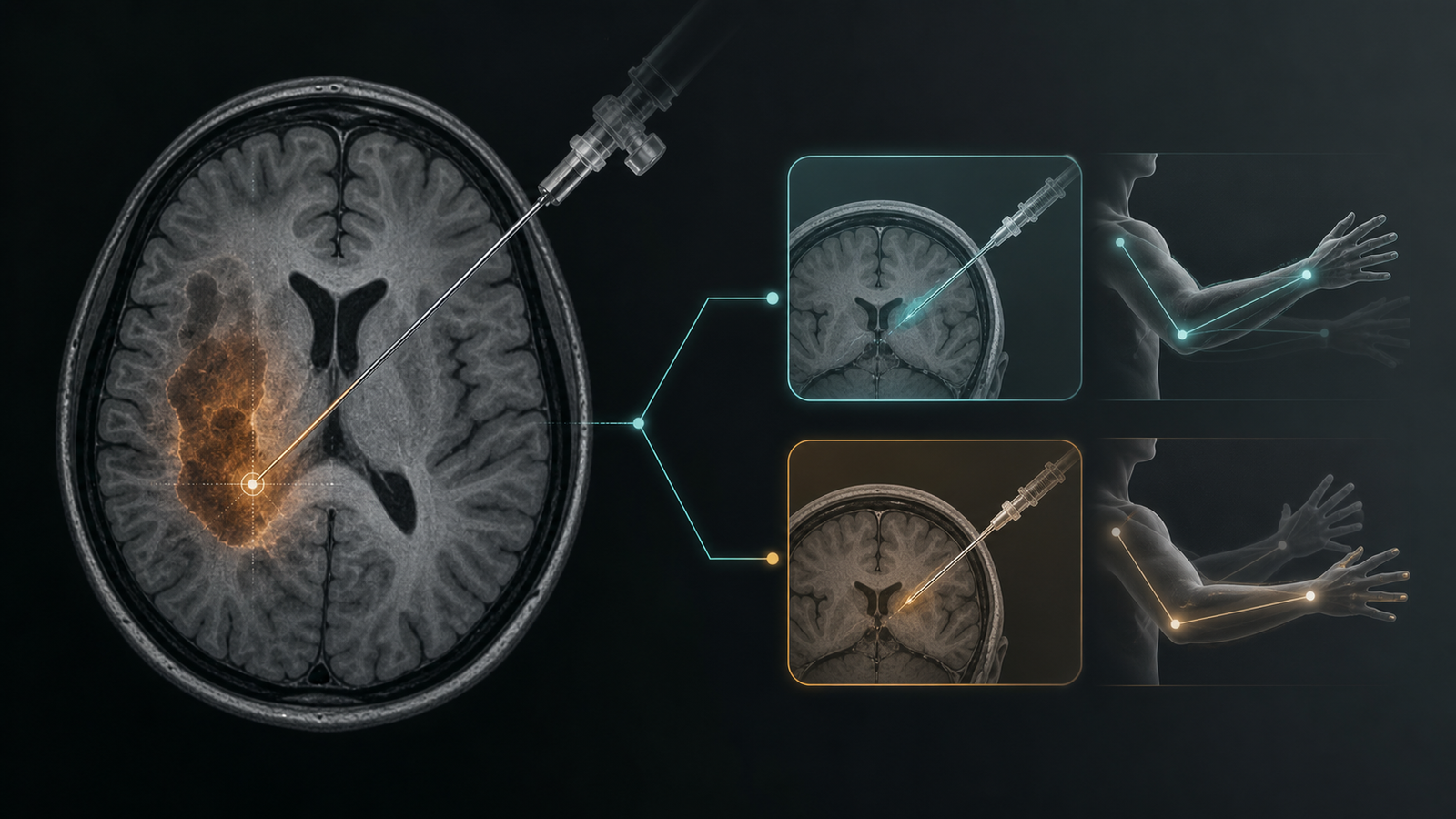
Editorial illustration of chronic stroke neural cell therapy moving from early follow-up toward controlled trial design. Credit: CellXperience generated editorial illustration.
Chronic stroke is one of the most emotionally compelling areas for regenerative medicine. It is also one of the easiest places to fool yourself.
Many patients live for years with motor disability after the main recovery window has slowed. Families see small changes clearly. Rehabilitation can still matter. Motivation, practice, baseline severity, and measurement timing can all shape functional scores. A surgical cell-therapy program in this setting has to do more than show that a patient improved after treatment. It has to show that the improvement is larger, more durable, and more credible than the recovery and assessment noise around it.
That is why the July 2026 chronic stroke updates are interesting. One update brings long-term clinical and imaging follow-up from hNPC01 into view. Another new trial record shows a Phase 2 CC-101 design with randomization, masking, sham surgery, tacrolimus, and a one-year motor endpoint.
The two programs should be read separately. Together, they show chronic stroke cell therapy moving toward the kind of clinical testing the field needs.
Primary sources
- ISSCR 2026 chronic stroke update on hNPC01 - https://www.isscr.org/isscr-news/long-term-clinical-data-advance-stem-cell-research-for-chronic-stroke-recovery-presented-today-at-isscr-2026-in-montral-canada
- ClinicalTrials.gov NCT06299033, hNPC01 - https://clinicaltrials.gov/study/NCT06299033
- ClinicalTrials.gov NCT07709845, CC-101 - https://clinicaltrials.gov/study/NCT07709845
The hNPC01 update is about long follow-up
ISSCR reported that Hopstem presented previously unpublished long-term clinical and imaging findings from participants treated with hNPC01, an iPSC-derived forebrain neural progenitor cell product for chronic ischemic stroke.
The related ClinicalTrials.gov record lists a Phase 1 study of hNPC01 in adults with chronic ischemic stroke, with 21 estimated participants, single-group assignment, no masking, and treatment-emergent adverse events during the first six months after intracerebral injection as the primary safety measure.
The ISSCR update describes adults who had experienced ischemic stroke between six months and five years before treatment and who continued to have persistent motor disability despite rehabilitation and standard care. That chronic window is important. It tries to enroll patients whose neurological function is relatively stable before treatment, so later changes can be interpreted with less confusion from the acute recovery phase.
The current public update is still conference-level reporting rather than a full peer-reviewed paper. That means readers should be careful about details such as magnitude of functional change, missing data, imaging interpretation, adverse events, and patient-level variability until the full dataset is available. But the core point is still useful: long-term follow-up is exactly what a neural progenitor cell product in chronic stroke has to build.
In brain repair, short follow-up can miss the most important questions. Do the cells persist? Does the lesion area change? Are there delayed safety issues? Do any functional gains hold? Does imaging tell a coherent story with clinical change? A chronic stroke program needs time to answer those questions.
The CC-101 record is about control
The newer July record comes from Clarion Cells. ClinicalTrials.gov lists CC-101, formerly NR1, as a not-yet-recruiting Phase 2 study in adults with chronic ischemic stroke.
The design is notable. The record lists 36 estimated participants, randomized parallel assignment, quadruple masking, and three groups. About two-thirds of participants are planned to receive intracerebral CC-101 transplantation, with or without active short-term oral tacrolimus. One-third are planned for a sham surgical control with matched placebo.
The primary outcome is the total Fugl-Meyer Motor Scale score at Day 365 after intervention, compared with baseline. That is a one-year motor endpoint in a chronic motor-disability population, not a short visit placed immediately after surgery.
This is the kind of design choice that changes how future results can be read.
For a surgical cell therapy, sham control is not a cosmetic feature. The procedure itself, the care around it, the patient expectation after neurosurgery, and the intensity of follow-up can all influence behavior and assessment. A masked comparator gives the study a better chance of separating a treatment effect from the experience of being treated.
The tacrolimus arms are also important. They let the study ask whether short-term immunosuppression affects the safety and performance of the cell product. That is not a side issue. If an allogeneic neural stem-cell therapy needs immune management, the drug regimen becomes part of the product's practical profile.
These are not the same product
It would be a mistake to treat hNPC01 and CC-101 as interchangeable just because both sit under neural cell therapy for chronic stroke.
hNPC01 is described as an iPSC-derived forebrain neural progenitor product. The public ISSCR update centers on long-term follow-up from Phase 1 experience.
CC-101 is described in the registry as an allogeneic neural stem-cell product administered stereotactically by intracerebral injection immediately adjacent to the prior stroke lesion. The July 2026 record centers on a planned Phase 2 design with randomization, sham surgery, and a one-year Fugl-Meyer endpoint.
Different cell products can behave differently. Different delivery plans can create different risks. Different immune strategies can change the burden on patients. Different trial designs can produce results that deserve different levels of confidence.
That specificity is especially important in stroke, where broad labels can blur the real clinical question. "Stem cells for stroke" is too vague to be useful. A neural progenitor product delivered into chronic stroke tissue under a defined surgical and immunological protocol is a much more concrete object to evaluate.
Why chronic stroke needs stronger designs
The chronic stroke population is not easy to study.
The attraction is obvious: patients may have persistent disability, a stable deficit, and few restorative options. That creates a compelling place to test neural repair.
The difficulty is just as real. Motor scores can improve with training. Patients may adapt functionally even years after stroke. Baseline impairment can vary widely. A small change in hand or arm function can matter to a patient, but it can also be difficult to separate from practice, motivation, rehabilitation intensity, or assessor expectation.
Chronic stroke remains a serious target. It demands unusually careful design.
A serious study has to define the lesion population, motor deficit, chronicity window, rehabilitation background, surgical procedure, immune regimen, follow-up length, and primary motor measure with enough care that a positive result can be trusted.
The CC-101 record is interesting because it appears to accept that burden. A randomized, masked, sham-controlled Phase 2 trial with Day 365 Fugl-Meyer motor assessment is a harder route, and it gives the answer a better chance to mean something.
How to read the field now
The right mood here is constructive patience.
hNPC01 gives chronic stroke cell therapy a human follow-up story to watch, especially around imaging and long-term behavior after intracerebral delivery. CC-101 gives the field a planned controlled design that can test whether a neural stem-cell product produces motor benefit beyond procedure, expectation, and follow-up effects.
Neither update makes neural cell transplantation an established chronic stroke therapy. Both make the next phase of the question more serious.
That is exactly where the field should be. Chronic stroke deserves ambitious repair strategies, but patients also deserve studies that can tell the difference between an inspiring recovery story and a treatment effect.