
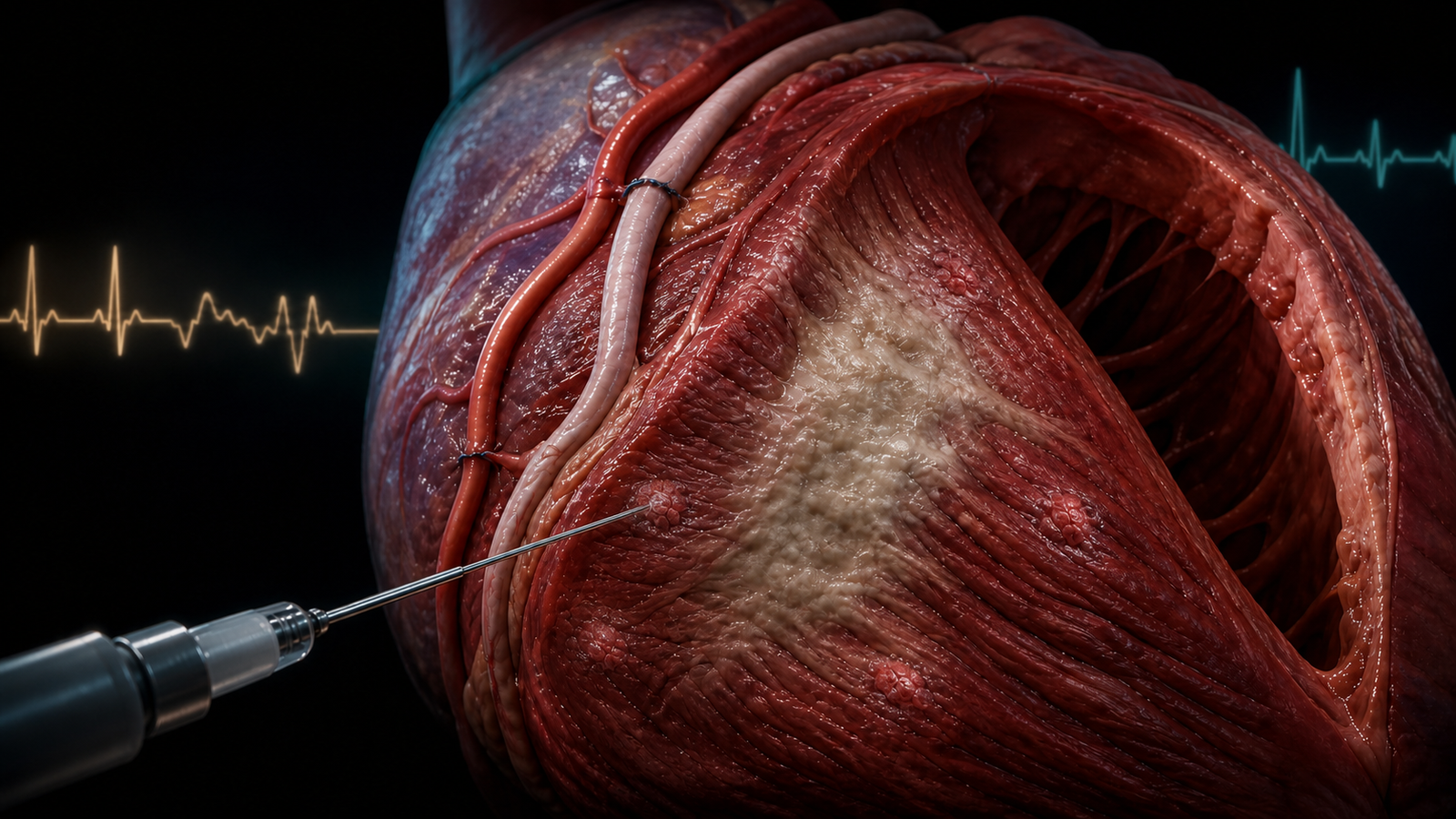
Editorial illustration of iPSC-derived cardiomyocytes injected around ischemic scar tissue during coronary bypass surgery. Credit: CellXperience generated editorial illustration.
The HEAL-CHF paper changes the tone of the cardiac-cell field. Ten people received 200 million allogeneic iPSC-derived cardiomyocytes during coronary bypass surgery. Ten underwent bypass surgery alone. A year later, the trial had produced functional changes worth carrying forward and an early rhythm problem serious enough to reshape the next protocol.
With 20 participants, the study cannot settle whether cardiomyocyte transplantation regenerates a failing human heart. It does give the field its first randomized look at direct iPSC-cardiomyocyte injection in advanced ischemic heart failure.
Primary sources
- Nature Medicine, "Intramyocardial injection of allogeneic human induced pluripotent stem cell-derived cardiomyocytes in advanced ischemic heart failure: an early-stage randomized trial" - https://www.nature.com/articles/s41591-026-04605-1
- Full Research Square manuscript and supplementary files - https://www.researchsquare.com/article/rs-7414031/v1
- ClinicalTrials.gov NCT03763136 - https://clinicaltrials.gov/study/NCT03763136
Two hundred million cells, delivered during bypass
HEAL-CHF was a single-center, open-label trial at Nanjing Drum Tower Hospital. The 20 participants had advanced ischemic heart failure, a left-ventricular ejection fraction of 45 percent or lower, persistent symptoms despite medical treatment, and a clinical indication for coronary artery bypass grafting. Eighteen were men and two were women.
Both groups received bypass surgery. In the experimental group, the surgeon completed the coronary anastomoses and then injected 200 million cardiomyocytes at ten sites around the infarcted region. The control group received no sham injections. Outcome assessors were blinded, while the surgical and postoperative teams knew the allocation.
This design gives every participant an active treatment capable of improving perfusion and ventricular function. It also avoids exposing control patients to ten placebo injections in an open heart. The tradeoff appears throughout the results: any additional improvement has to be found on top of bypass surgery, while knowledge of treatment and the absence of a sham procedure can still influence functional assessments.
The cardiomyocytes were generated from reprogrammed peripheral-blood cells in GMP laboratories operated by HELP Therapeutics, then cryopreserved, transported to the hospital, thawed, and suspended in albumin before implantation. Their allogeneic origin makes an off-the-shelf product possible and brings immune rejection into the treatment.
The arrhythmias arrived before month one
The prespecified primary rhythm endpoint covered sustained ventricular tachycardia from one to six months after surgery. No participant in either group experienced that event during the window.
Most of the ventricular irritability happened earlier. Every cell-treated participant developed accelerated idioventricular rhythm, usually beginning five to seven days after transplantation. Two developed ventricular tachycardia above 140 beats per minute at two to three weeks, prolonging their hospital stays and requiring cardioversion. Both returned to sinus rhythm, and the paper reports no later recurrence.
One cell-treated participant had ventricular fibrillation on postoperative day two, which the investigators attributed to surgery rather than the graft. Across the trial, seven serious adverse events occurred in four participants. Six events were reported in three members of the cell group: the two ventricular-tachycardia episodes, the early ventricular fibrillation, cardiac dysfunction, and separate liver and kidney injuries attributed to immunosuppressive drugs. The organ injuries resolved after the medication was adjusted. One control participant died suddenly at home eight months after surgery; no autopsy was performed.
The timing supports the authors' concern about immature cardiomyocytes generating ectopic impulses while they adapt and mature. Similar arrhythmias have appeared in large-animal transplantation studies. Conventional antiarrhythmic treatment did not reliably suppress the burden here, and ivabradine was stopped after use in three participants because it failed to control ventricular-tachycardia frequency.
The trial therefore met its defined ventricular-tachycardia endpoint while exposing a clinically important event pattern during the first postoperative month. Future protocols will need monitoring and treatment plans built for that early period, rather than beginning their main rhythm interpretation after it.
No tumors at one year
Pluripotent-cell products carry a second concern: residual undifferentiated cells can proliferate or form unwanted tissue. FDG PET-CT detected no new tumors in the cell-treated group at 12 months.
That result agrees with the investigators' earlier two-patient experience, which has longer follow-up. It is still one year of formal observation in ten randomized recipients. Tumor surveillance has to continue as the treated population grows, but the result removes an immediate obstacle that could have stopped the program before efficacy was worth discussing.
Walking distance moved; ejection fraction did not
Both groups improved after bypass surgery. The cell group recorded a larger increase in six-minute walking distance. At 12 months, the mean change from baseline was about 169 meters with cells and 97 meters in controls, a statistically significant difference. The absolute distances at 12 months were 489 and 432 meters, respectively; that between-group comparison fell short of statistical significance.
Myocardial perfusion and wall thickening also favored the cell group in change-from-baseline analyses. The perfusion result needs extra care because the cell group began with significantly worse perfusion. A poorer starting value creates room for a larger rebound and raises the possibility of regression toward the mean, which the authors acknowledge.
Several familiar heart-failure measures did not separate. At 12 months, there were no significant between-group differences in ejection fraction, ventricular volumes, scar size, NYHA functional class, or Minnesota Living with Heart Failure Questionnaire score. The mean improvement in ejection fraction was almost identical: 4.67 percentage points in the cell group and 4.80 in controls.
The walking and imaging findings justify a larger efficacy study. Durable contractile muscle has not been demonstrated. The study did not directly measure graft persistence, leaving open whether surviving donor cardiomyocytes produced force, short-lived cells altered the surrounding tissue through secreted factors, or several mechanisms acted together.
One control participant died after the six-month visit. The 12-month analysis carried that participant's last available measurements forward. In a trial this small, the handling of a single missing follow-up can affect the apparent size of a group difference.
A one-month immune regimen leaves a biological question
The immune protocol was brief and intensive. Cell-treated participants received intravenous immunoglobulin, methylprednisolone, rituximab, tacrolimus, mycophenolate mofetil, and prednisone around the operation. Tacrolimus, mycophenolate, and prednisone continued through postoperative day 28. Controls received no immunosuppression.
Donor-specific antibodies appeared despite that regimen. None of the ten recipients had them at baseline. Four tested positive at one month, eight of nine assessed participants at six months, and four of nine at 12 months. The antibodies were clinically silent during the reported year, but their presence shows that the graft did not remain immunologically invisible.
Durable remuscularization requires living donor cardiomyocytes that remain electrically and mechanically integrated. Rejection after temporary immunosuppression would shorten graft survival and shift the plausible benefit toward effects initiated while the cells were present, such as angiogenesis or changes in fibrosis. HEAL-CHF was not designed to resolve that mechanism.
The immune burden also reached patients. The serious liver and kidney events attributed to immunosuppressive drugs resolved, yet they show why indefinite treatment would be difficult in a population that often already has renal or hepatic vulnerability. Cell engineering, HLA matching, local immune strategies, or a different graft format may eventually reduce that burden. The present trial cannot assume the problem away.
What a larger trial needs to measure
HELP Therapeutics manufactured the cells and is listed as the registry sponsor. Several authors are employees, one is a scientific founder and equity holder, and another is a medical consultant. Proprietary products commonly enter early trials with deep sponsor involvement. Multicenter testing, prespecified analysis, and independent outcome assessment become increasingly important once efficacy is the claim under examination.
A larger trial will need continuous rhythm monitoring across the first postoperative month, a defined response plan for graft-related ventricular tachycardia, and longer tumor surveillance. It should also track donor-cell persistence or provide a stronger mechanistic surrogate. Efficacy endpoints need enough participants to withstand baseline imbalances and the large effect of bypass surgery itself.
HEAL-CHF has made those demands concrete. The next study will have to show that any added cardiac benefit is large and durable enough to justify early ventricular instability, invasive delivery, and immune management.