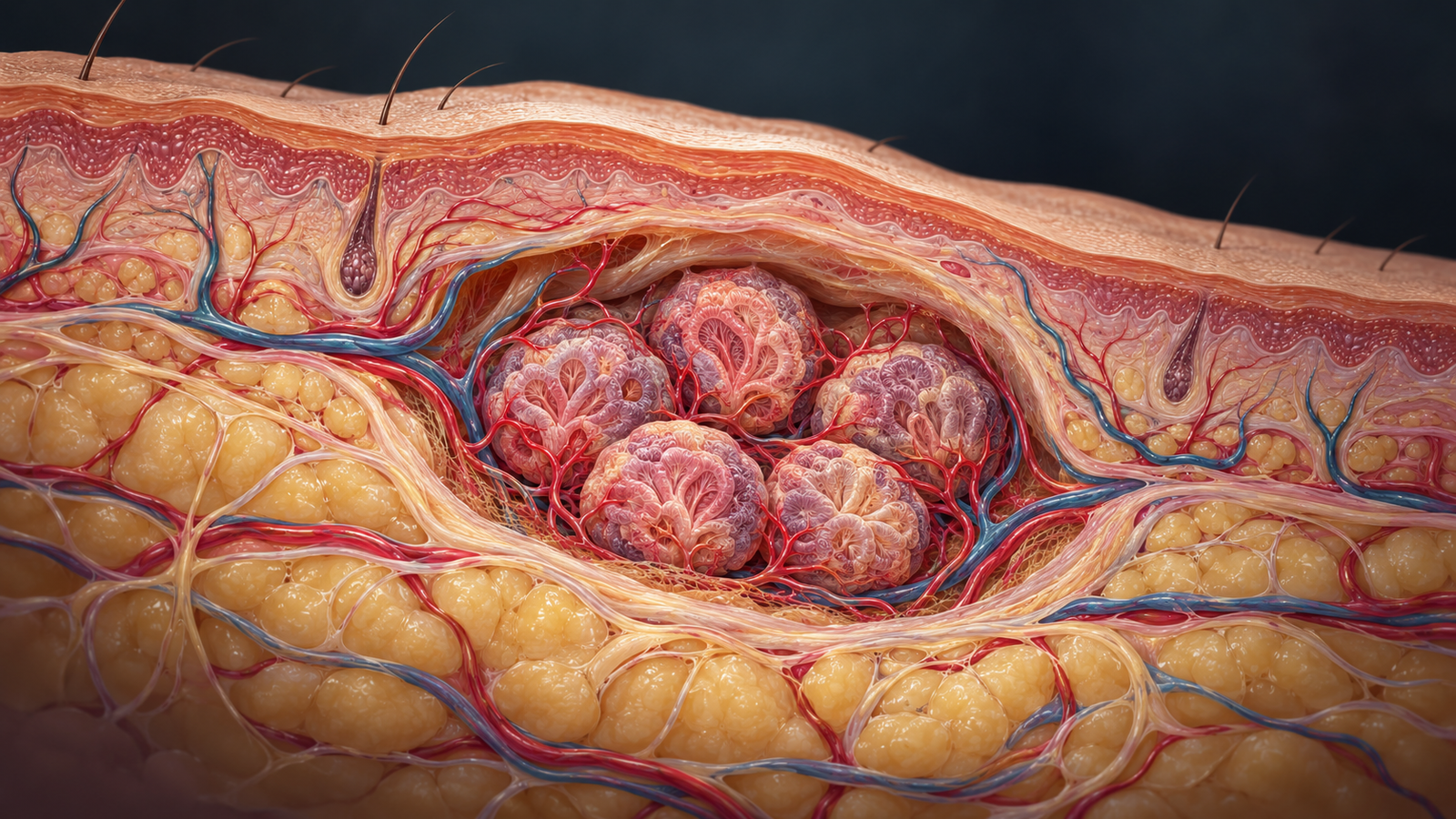
Generated editorial illustration of pituitary-hypothalamus organoids in a prepared subcutaneous graft pocket. Credit: CellXperience.
The pituitary gland is tucked beneath the brain, yet several of its hormones do their work at a distance. That raises an unusual transplantation question. If lab-grown pituitary tissue can sense the right circulating signal and release hormone back into the blood, does a replacement graft need to occupy the gland’s original location?
A study published in Stem Cell Research & Therapy on October 2 gives a partial answer. Researchers made pituitary-hypothalamus organoids from human embryonic stem cells and implanted them into pockets under the skin or within muscle. In hypopituitary mice, the grafts released adrenocorticotropic hormone, responded to a physiological stimulus, and prolonged survival. A single cynomolgus monkey experiment carried the method across species and exposed the immune challenge that now sits in its path.
The work is a xenotransplantation study in animals. It does not show that a pituitary organoid transplant is ready for people. It does, however, test endocrine function in a site that surgeons can reach and monitor more easily than the base of the brain.
Building a small endocrine tissue
The team used the KhES-1 human embryonic stem cell line and a three-dimensional differentiation protocol that generates neighboring pituitary and hypothalamic tissue. Their organoids were cultured for 100 to 200 days. ACTH-producing corticotrophs developed within the pituitary portion, while the adjoining hypothalamic tissue supplied a local developmental context.
ACTH controls the adrenal response to stress. In the intact body, hypothalamic corticotropin-releasing hormone, or CRH, stimulates pituitary corticotrophs to release ACTH. ACTH then prompts the adrenal cortex to produce glucocorticoids. Removal of the pituitary breaks that chain and can lead to fatal adrenal insufficiency.
The researchers removed the pituitary gland from immunodeficient mice and confirmed low ACTH responses before transplantation. Five organoids were then placed in one of three sites: an axillary fat pocket, an inguinal fat pocket, or gluteal muscle. Sham-operated animals received an incision without organoids.
That layout tests more than convenience. Fat and muscle offer different vascular and mechanical environments. A graft that remains isolated from the circulation may contain the right cells and still fail because oxygen, nutrients, incoming CRH, and outgoing ACTH cannot move efficiently.
ACTH appears and remains responsive
Six months after transplantation, the three graft sites produced broadly similar endocrine results. In the site-comparison experiment, the median basal ACTH concentration was 42 picograms per milliliter in transplanted mice and undetectable in sham controls. After CRH stimulation, the medians were 112 and 1.84 picograms per milliliter. Both differences met the study’s statistical threshold.
The CRH response is important because a fixed hormone leak would be a poor substitute for endocrine regulation. The organoids retained enough input-output behavior to respond when the upstream signal was supplied. Histology found ACTH-positive human tissue at the graft sites, with blood vessels extending into the transplant.
Survival supplied a second, coarser measure. All three transplant groups lived longer than sham animals after hypophysectomy. The paper reports a log-rank chi-square value of 30.5 across the four groups. The study used 71 mice across several experiments, while the direct graft-site comparison was smaller: four sham animals, five with axillary grafts, six with inguinal grafts, and six with muscle grafts.
Few graft cells stained for Ki67 at roughly six months, and the authors did not observe abnormal proliferative tissue in the examined mice. That is reassuring within this experiment. It is not a tumor-risk assessment across large cohorts, longer periods, or a clinical manufacturing process.
Preparing the pocket before the graft arrives
The team next tried to improve blood supply before transplantation. A collagen sheet carrying basic fibroblast growth factor, heparin, and hyaluronate was placed beneath the skin for one week. The sheet was removed, leaving a vascularized pocket, and five organoids were inserted into that prepared site.
Pretreated pockets supported more vascular ingrowth and higher ACTH output than avascular pockets. The experiment makes the recipient site part of the therapeutic design. The transplant is not simply a cluster of differentiated cells. It is a cell product placed into tissue that has been modified to receive it.
This strategy also separates two jobs in time. Angiogenesis begins before the organoid faces the oxygen demands of engraftment. The temporary sheet is gone when the cells arrive, which may be simpler than leaving a permanent scaffold beside the graft. Whether the approach is reproducible and safe at human scale remains open.
One monkey shows function and rejection
For the primate experiment, the researchers hypophysectomized one 15-year-old male cynomolgus monkey. They prepared a subcutaneous pocket with the same angiogenic concept, transplanted 1,440 organoids, and administered tacrolimus, mycophenolate mofetil, etanercept, and rabbit anti-thymocyte globulin. Hydrocortisone replacement was stopped six days after transplantation.
Mean basal ACTH rose from 1.5 picograms per milliliter before transplantation to 6.33 afterward. The animal’s weight had been falling before the graft; during the period in which graft function was inferred, that decline flattened. These observations are compatible with endocrine activity, though they come from one animal without a control.
The follow-up became difficult. Severe debilitation prevented sufficient blood collection after six weeks. At three months, the graft still contained ACTH-positive cells and vascular connections. It also contained CD3-positive T cells, CD20-positive B cells, and CD68-positive macrophages. The pathology indicated immune rejection despite the intensive regimen.
No disseminated graft tissue was found in the sampled liver or lungs. That observation cannot substitute for a larger biodistribution study, but it helps define what was checked in this animal.
The primate result should be read as a feasibility signal paired with a warning. Human cells can survive and secrete hormone for a limited period in a prepared primate pocket. Xenogeneic immunity can then overwhelm the graft under conditions that already demand substantial immunosuppression.
A reachable site changes the clinical problem
Pituitary replacement is often imagined as a neurosurgical task because the native gland sits below the brain. A subcutaneous graft would change the practical problem. Surgeons could place, inspect, biopsy, or remove it without entering the skull. More than one pocket could be used, and a failed graft might be exchanged.
That accessibility carries its own requirements. Hormone delivery has to remain regulated across illness, stress, sleep, and changing steroid needs. A graft producing too little ACTH would not protect against adrenal crisis; a graft producing too much could cause chronic cortisol excess. The mouse CRH test establishes responsiveness under an experimental challenge, not full physiological control.
Cell identity and purity also need deeper qualification. The organoids were long-lived, multicellular tissues derived from pluripotent cells. Release testing would need to address residual undifferentiated cells, the proportion and maturity of hormone-producing cells, unwanted lineages, genomic stability, and batch consistency. Immune protection may require a compatible donor strategy, engineered cells, a retrievable device, or a different form of immunomodulation.
The next informative experiment would use more primates, prespecified hormone and clinical endpoints, longer sampling, and a plan that distinguishes graft failure from complications of hypophysectomy or immunosuppression. It should also test whether the vascularized pocket can be made consistently and whether a failing graft can be removed safely.
The paper earns attention because the graft performed an endocrine task from an anatomically unconventional site. Its strongest result comes from mice. Its most instructive result may be the rejected primate graft, which shows that access and vascularization solve only part of the replacement problem.
Source and disclosures
This analysis uses the complete open article, “hESC-derived ACTH-producing organoids restore pituitary function in hypopituitary mice and a non-human primate”, published October 2, 2026. The study reports funding from public Japanese agencies, Nagoya University Hospital, RACTHERA, Sumitomo Chemical, and Sumitomo Pharma. Several authors were company employees or co-inventors on related patent applications. The hero is an original generated editorial illustration and does not depict measured study data or the study animals.