
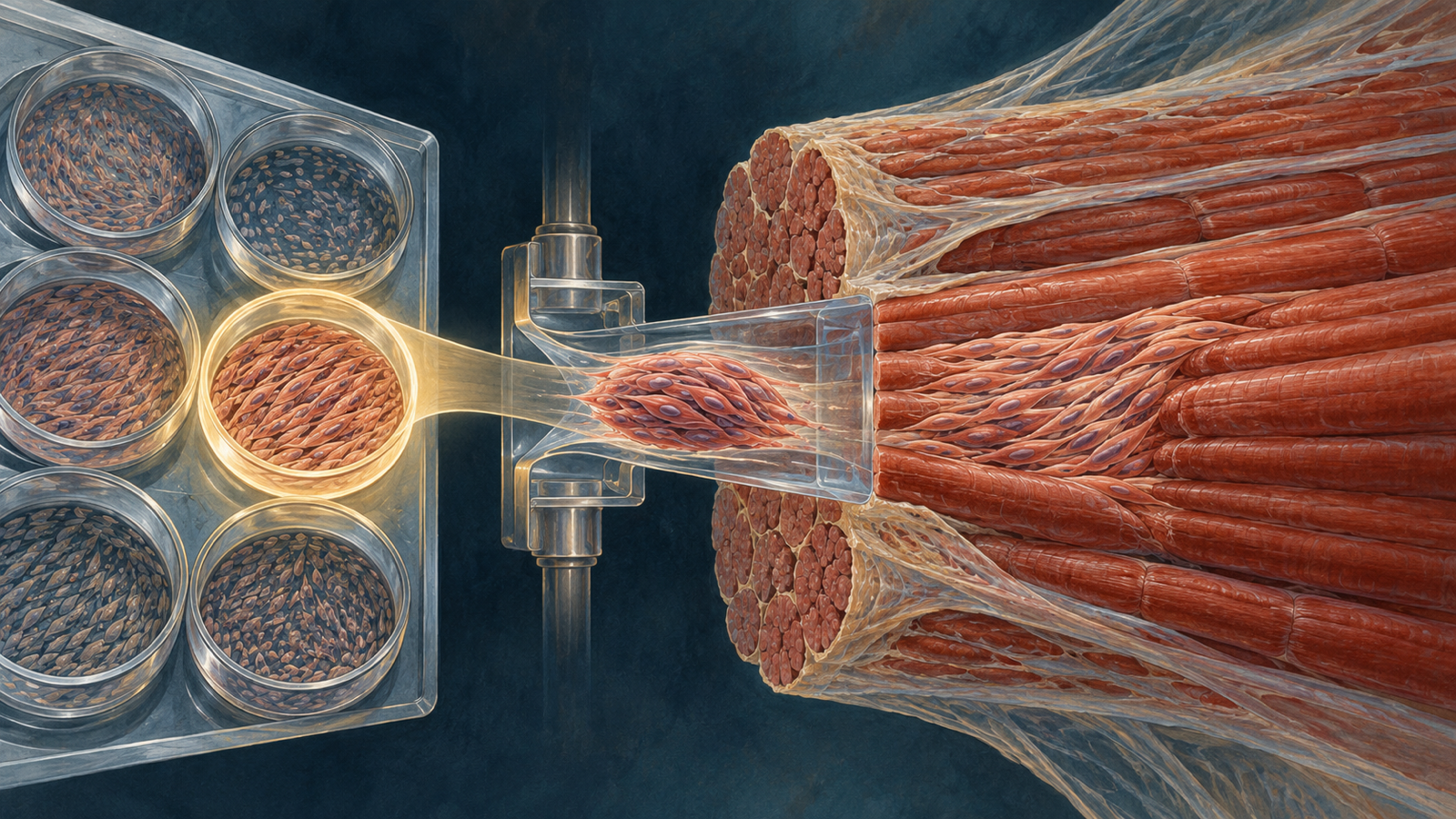
Generated editorial illustration of donor-line screening and intramuscular engraftment. It is not study microscopy and does not depict a clinical procedure. Credit: CellXperience.
The best-matched donor was not the best muscle builder.
In a Stem Cell Reports paper published online October 15, researchers compared myogenic progenitors made from induced pluripotent stem cells of MHC-typed cynomolgus macaques. Their study began with a broad potency screen and ended with a small, controlled transplantation experiment in nonhuman primates. A fully mismatched donor line with strong regenerative performance produced many more donor-derived muscle fibers than a partially matched line that had performed poorly before transplantation.
The finding has an immediate manufacturing implication: donor selection cannot rest on histocompatibility alone. Its immunologic meaning is narrower. The allogeneic recipients received tacrolimus, follow-up lasted 28 days, and the study paired one high-performing mismatched donor with one low-performing partially matched donor. Potency and matching were therefore entangled by design.
Seventy-two clones reveal a wide potency range
The team generated iPSC lines from five Mauritian-origin cynomolgus macaques whose major histocompatibility complex haplotypes were known. A doxycycline-inducible PAX7 system directed the cells toward expandable skeletal-muscle progenitors. Between 10 and 42 iPSC clones were derived per donor, and 72 independent clones entered an initial in vivo screen.
That screen used cardiotoxin-injured muscles in immunodeficient mice. Donor-derived fibers were identified by a linked red fluorescent protein and dystrophin staining. The purpose was practical: find out whether lines that looked broadly myogenic in culture could differ once asked to regenerate tissue.
They did. Clone 2 from donor 22BP9 generated averages of 458 donor-derived fibers in abductor pollicis brevis muscle and 477 in extensor digitorum brevis muscle. Clone 5 from the same donor remained productive, though less so. The selected 23CP14 clones were much weaker; clone 36 produced averages of 19 and 33 fibers, while clone 24 generated 47 fibers in the comparison highlighted by the authors.
The spread preceded any cross-donor immune comparison. It was an intrinsic property of the donor-cell preparations as tested in the same permissive mouse setting. That observation shaped the primate experiment: 22BP9 supplied the high-potency mismatched graft, and 23CP14 supplied the lower-potency partially matched graft.
Each recipient carried four conditions
The allogeneic experiment involved three recipients: 23CP15, 23CP7, and 21JP8. Each animal served as its own comparison across four muscle sites. One site received progenitors from 22BP9, which was fully MHC mismatched to all three recipients. A second received progenitors from 23CP14, which was partially matched. A third received an autologous progenitor preparation. The remaining site received vehicle.
Muscles were injured with cardiotoxin before transplantation. Each cell-treated site received about 102 million myogenic progenitors. Tacrolimus was given daily, with blood levels monitored, and tissue was collected at day 28.
The mismatched 22BP9 line produced 60, 230, and 97 donor-derived fibers across the three recipients. The partially matched 23CP14 line produced 12, 22, and 15. Depending on the animal, the high-potency donor therefore generated roughly five to ten times as many fibers. Histology also suggested a qualitative difference: 22BP9 cells contributed to mature-looking dystrophin-positive fibers, while more 23CP14 cells remained in interstitial positions.
Allogeneic engraftment was lower than the corresponding autologous performance, so the experiment does not erase an immune cost. It shows that the starting gap between donor lines was large enough to overwhelm the advantage of partial matching in this short, immunosuppressed assay.
The immune readout is reassuring and tightly bounded
Serum and cellular assays did not show a clear increase in donor-specific sensitization during the 28-day study. The team measured donor-reactive IgG and IgM binding, along with proliferation of CD4, CD8, and CD20 populations. No obvious donor-specific response emerged under tacrolimus monotherapy.
Several boundaries keep that result from supporting an intrinsically hypoimmune claim. Tacrolimus was active throughout the observation period. The endpoint arrived before a durable graft response or immunosuppression withdrawal could be studied. The low-performing partially matched line also supplied little graft material, reducing the antigenic comparison that matching was supposed to test.
The authors acknowledge that their design cannot determine the independent contribution of partial versus complete mismatch. A longer experiment with planned tacrolimus withdrawal, balanced donor potency, and serial immune measurements would address a different and more clinically useful question.
Transcription points toward a potency assay
Bulk RNA sequencing separated the donor lines by transcriptional identity. The 22BP9 progenitors expressed more PAX7 and showed differences in myogenic and cell-cycle programs. Gene-set analysis highlighted chromosome and centromere processes, and cell-cycle measurements suggested a distinctive balance around the G1/S transition.
These signals are candidates, not a release assay. PAX7 expression alone did not neatly rank every donor, and the study did not prospectively use a molecular score to predict engraftment in an unseen line. The valuable next step is to convert the retrospective signature into a test: measure a candidate panel before transplantation, lock the threshold, and ask whether it predicts fiber formation across additional donors and manufacturing runs.
Such an assay would help solve a central problem in off-the-shelf cell therapy. A bank can optimize HLA coverage, yet a well-matched vial offers little value if its cells expand poorly, fail to survive handling, or lose regenerative capacity after differentiation. Potency must be measured in a way that tracks the biological task expected after delivery.
What the study leaves open
The grafts were assessed by histology, without muscle-strength testing. The recipients did not have muscular dystrophy. Cardiotoxin created a synchronized injury that supports regeneration, and every animal was male. Three allogeneic recipients provide a controlled within-animal comparison, though they cannot describe population variability or uncommon safety events. The authors performed no formal a priori sample-size calculation because the work was exploratory.
The strongest experiment now would cross potency and matching rather than allowing them to travel together. High- and low-potency donor lines should each be tested across matched, partially matched, and mismatched recipients. Functional force, graft persistence, immune infiltration, and genomic safety need longer follow-up. A dystrophic model would then reveal whether new fibers carry enough corrected protein and mechanical capacity to change disease.
This paper changes the order of operations. It argues for finding a reliably regenerative line before narrowing a bank around immune compatibility. The data support that priority during early engraftment under tacrolimus. They do not settle how much matching will matter after immunosuppression is reduced or the graft is asked to work for years.
Source and disclosures
This analysis uses the complete open Stem Cell Reports article, “Donor-intrinsic regenerative potential outweighs histocompatibility in iPSC-derived skeletal muscle engraftment in nonhuman primates”, available online October 15, 2026, together with its embedded supplemental methods and figures. The authors report public and nonprofit funding. Rita C.R. Perlingeiro is disclosed as a cofounder of and equity holder in Myogenica. The hero is an original generated editorial illustration, not primary evidence.