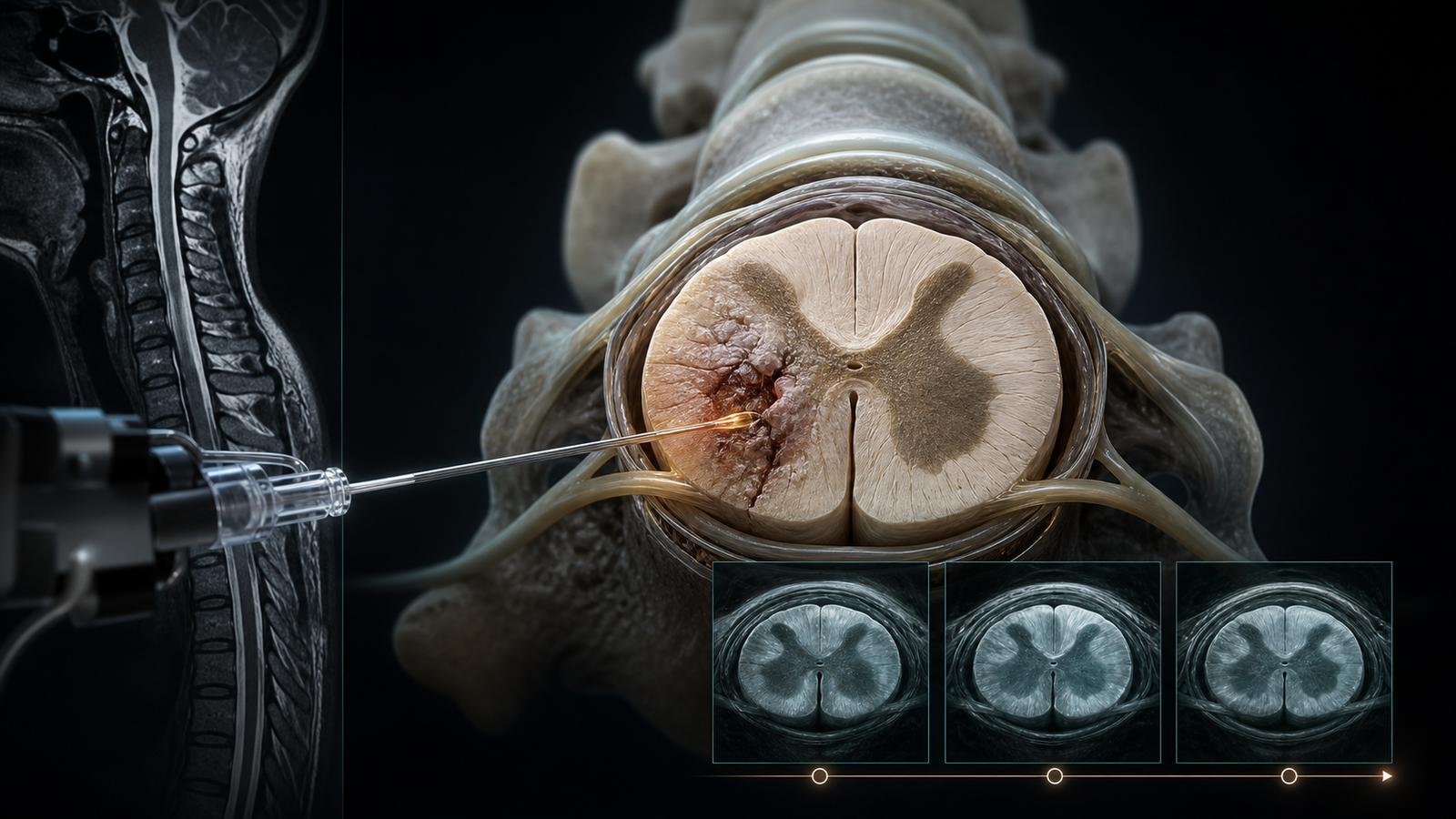
Editorial illustration of direct spinal cord delivery, iPSC-derived neural progenitor cells, and long-term imaging follow-up. Credit: CellXperience generated editorial illustration.
A first-in-human spinal cord injury study can be important without looking dramatic. In this case, the most important sentence is the quiet one: four people received iPSC-derived neural stem/progenitor cells directly into the injured cervical spinal cord, and the authors report no tumor formation or graft-related adverse events during 2-4 years of follow-up.
For this therapy class, that is a meaningful step before the recovery question can even be asked. The cells come from a pluripotent source. They are placed into the spinal cord. The treatment requires neurosurgery, imaging surveillance, rehabilitation, and temporary immunosuppression. A study like this has to earn confidence piece by piece.
Primary sources
- Nature Medicine: "An iPSC-derived neural progenitor cell therapy for subacute spinal cord injury: a phase 1 trial with long-term follow-up" - https://www.nature.com/articles/s41591-026-04549-6
- Trial registrations listed by the article: UMIN000035074, UMIN000050104, jRCTa031190228
What was actually tested
The Nature Medicine paper reports a Phase 1, open-label study from Keio University and collaborators. Four men with subacute traumatic cervical complete spinal cord injury were treated. Their neurological level of injury was between C4 and C6, and all were classified as AIS grade A before transplantation.
The product was an iPSC-derived neural stem/progenitor cell preparation. The starting iPSC line came from a clinical-grade donor source and was differentiated into neural stem/progenitor cells under a manufacturing process with predefined quality controls. Before surgery, the cells were thawed, recovered in culture, exposed briefly to a gamma-secretase inhibitor as part of the preparation process, washed, and resuspended for injection.
Each participant received 2 million cells injected into the lesion epicenter of the injured spinal cord. The authors describe intramedullary delivery under ultrasound guidance, with the injection performed slowly and directly into the target site.
This was not a simple infusion. It was a localized cell transplant into damaged spinal cord tissue, followed by serial MRI, PET imaging during the interventional period, neurological assessments, and long-term observational follow-up.
The safety result is the main event
The primary question was safety over the first 52 weeks, then longer follow-up. On that point, the paper is encouraging.
All four participants completed the planned 52-week interventional period. The authors report no serious adverse events attributed to the transplanted cells and no imaging findings suggestive of tumor formation or abnormal graft-site proliferation. During longer follow-up, which ranged from 2 to 4 years after transplantation, they again report no late serious adverse events, progressive neurological deterioration, or radiological evidence of tumor formation or abnormal cell growth related to the graft.
The treatment was still heavy. The paper reports adverse events connected to the surgical procedure and to tacrolimus immunosuppression. Tacrolimus was started around transplantation, continued for six months, and tapered off by month nine. Mild or moderate events considered related to tacrolimus included issues such as hypomagnesemia and urinary tract infection.
Those details belong in the article because they are part of the therapy. For a neural cell transplant, safety is not only about whether the cells behave. It is also about whether the full treatment can be delivered without creating unacceptable surgical, immunological, or monitoring burden.
The recovery findings are encouraging, but early
The paper also reports exploratory neurological outcomes. Median ISNCSCI motor score improved by 13 points at week 52, with a range of 10-40. Two participants improved in AIS grade, one from A to C and one from A to D. The authors compare these changes with a registry-based historical cohort and describe the treated patients' gains as numerically greater than spontaneous recovery observed in that comparator set.
Those observations are worth taking seriously. Cervical complete spinal cord injury is a difficult setting, and multi-year human follow-up after direct iPSC-derived neural cell delivery is rare.
They are not, by themselves, proof that the cells caused the recovery. There were four treated participants, no randomized control group, and no sham procedure. Spinal cord injury recovery can vary, especially in the subacute period. Surgical stabilization, rehabilitation, baseline biology, and measurement timing all matter.
The fairest reading is therefore positive but narrow. The study shows that this product and delivery approach can be taken into humans and followed for years without the major safety problems that would stop the program at the door. It also gives enough functional movement in the data to justify asking the next question in a stronger design.
Why the follow-up length matters
The long follow-up is not a cosmetic detail. Pluripotent stem-cell-derived products raise specific safety questions because of proliferation, maturation, genomic stability, and the possibility of unwanted tissue growth. A clean early postoperative course is useful, but it is not enough.
In this study, the authors followed graft sites by serial MRI, used PET during the first year, and continued neurological and imaging surveillance afterward. The absence of tumor-like growth over 2-4 years leaves some long-term questions open. It still makes the human safety story more credible than a short 3- or 6-month update would.
It also matters because the field needs examples of how these programs can be monitored. Cell therapy for spinal cord injury will not be judged only by a motor score. It will be judged by whether patients can undergo the procedure, tolerate immunosuppression, avoid late graft problems, and show changes that persist beyond the early recovery window.
What the next study has to do
The next stage cannot answer every question at once. Its job is to separate the most important ones.
The safety findings have to hold in more patients. Four treated participants are enough to start a human story; they are not enough to define the risk profile of a neurosurgical cell product.
The recovery question also needs a design that can handle the natural variability of spinal cord injury. That could mean a larger controlled study, carefully matched contemporaneous controls, a clearer dose strategy, and prespecified functional endpoints that are hard to move by expectation alone.
The field will also need to understand who is most likely to benefit. Subacute cervical complete injury is not the same as chronic injury, thoracic injury, incomplete injury, or a different timing window after trauma. A positive program will eventually have to define its patient population with clinical realism.
How to read it now
This is a good-news study within a narrow lane.
The good news is that an iPSC-derived neural stem/progenitor product was manufactured, surgically delivered into the injured human spinal cord, paired with temporary immunosuppression, and followed for years without the safety findings that would make further development hard to defend.
The unresolved part is whether the treatment can reliably improve recovery beyond what would happen with standard care, rehabilitation, and the variable natural history of subacute spinal cord injury.
The distinction gives the paper its value. It moves the program from plausible biology into real human delivery, and it gives the next trial a much firmer place to stand.