
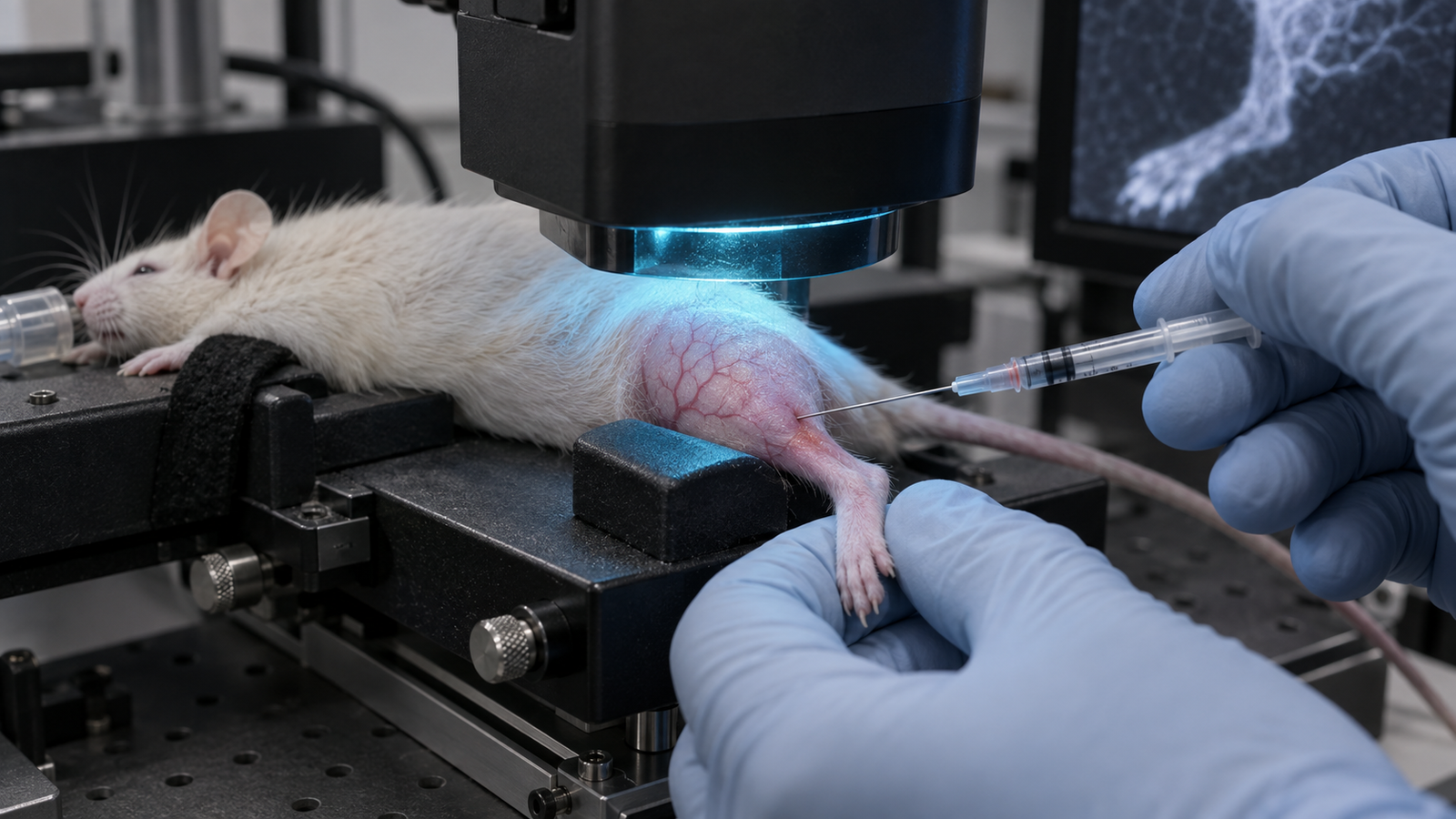
Editorial illustration of cell delivery and perfusion measurement in a preclinical mouse hindlimb-ischemia experiment. Credit: CellXperience generated editorial illustration.
Pluripotent-stem-cell-derived vascular cells have produced a remarkably consistent result in mouse limb ischemia: blood-flow measurements improve after treatment. A new systematic review finds that positive direction across study design, cell source, route, and analysis choices.
These products are often justified as cells that can help construct blood vessels. Across 68 studies, donor cells were resolved within a vessel wall in 35. Flow through a donor-containing vessel was shown in seven. Studies with stronger structural-incorporation evidence did not report larger perfusion effects.
The review does not erase the efficacy signal. It separates that signal from the mechanism used to explain it, and then asks whether a literature dominated by healthy young mice and unblinded perfusion imaging is ready to support a human program.
Primary source
The complete manuscript was posted September 9, 2026. It is a preprint and has not been certified by peer review. The protocol was registered on PROSPERO, and the authors link the extraction files, risk-of-bias decisions, data, and analysis code through OSF. They declare no competing interest.
The review arrived as human translation began
Chronic limb-threatening ischemia is an advanced form of peripheral artery disease. Patients face pain, tissue loss, amputation, and high mortality, and some cannot receive a durable conventional revascularization. Cell therapy has been tested for years as another way to improve perfusion.
Pluripotent stem cells change the manufacturing proposition. They can provide a renewable source of endothelial cells, vascular progenitors, pericytes, or structured vascular products. In principle, a defined bank could avoid the age and vascular dysfunction carried by autologous adult-cell sources.
The preprint says the first reported administration of autologous iPSC-derived endothelial cells to a person with peripheral artery disease occurred in Korea in August 2026. That timing raises a practical question. What, exactly, does the accumulated animal literature establish as the field crosses into human testing?
The review addressed two connected claims. First, do PSC-derived vascular cells improve perfusion in animal limb ischemia? Second, does the degree of donor-cell participation in vessels predict that improvement?
Sixty-eight studies enter, but only fifty-one support the primary pool
The authors searched MEDLINE, Web of Science, Europe PMC, and Embase from inception through August 2026. Eligible studies delivered a pluripotent-stem-cell-derived vascular product in an animal model of hindlimb or forelimb ischemia, included an acellular comparator, and measured limb perfusion. MSC-like derivatives were excluded because the review focused on vascular lineages.
Sixty-eight studies described in 69 reports met the criteria. Fifty-one contributed 114 treatment comparisons at the primary time point. The remaining studies stayed in the narrative review because their perfusion data, control, or reporting could not support a standardized effect.
Two reviewers independently screened records, assessed full texts, extracted data, and graded donor-cell fate. Only 19 of 68 studies reported at least some perfusion values numerically. Forty-five required values to be digitized from figures. The review repeated digitization and reported very high agreement, but dependence on plots shows how much analysis rested on data that were never published in a directly reusable form.
The primary model accounted for multiple comparisons nested within studies and used cluster-robust variance. Prespecified moderators included cell source, cell type, dose route, host immune status, comorbidity, delivery vehicle, treatment timing, and donor-cell fate. Functional and limb-preservation outcomes were analyzed separately when they could be reconciled.
This is a more demanding design than a simple tally of positive papers. It also inherits the definitions and reporting choices of the original experiments.
Perfusion favors treatment, with a magnitude that refuses to settle
The pooled standardized effect on perfusion was large: Hedges' g 2.26, with a 95% confidence interval from 1.72 to 2.79. A separate ratio-of-means analysis put perfusion recovery at 1.96 times the matched control, with a 95% interval from 1.66 to 2.33.
The direction survived the review's sensitivity tests. Estimates remained positive at fixed 14- and 28-day windows, after removing influential studies, under different assumptions about dispersion, and when the analysis was restricted to better-reported experiments. The subset of eight studies that both randomized treatment and blinded outcome assessment still favored treatment, with g 1.89 and a wide confidence interval from 0.73 to 3.05.
The size is much less secure. Heterogeneity reached 87.5%, and the 95% prediction interval for a new experiment ran from -1.47 to 5.98. A value below zero is compatible with harm or no benefit, while the upper end is extraordinarily large. No prespecified moderator survived correction for multiple testing.
Funnel asymmetry was strong under standard tests, and trim-and-fill reduced the pooled estimate to 1.15. A sample-size-based test designed to avoid the mechanical link between a standardized effect and its standard error found no significant asymmetry. The manuscript therefore treats the small-study signal carefully: some inflation is plausible, while part of the pattern may come from the effect-size measure itself.
The stable conclusion concerns direction. Cell-treated limbs generally showed higher measured perfusion than acellular controls. The pooled number should not be carried into a trial as a reliable planning estimate.
Limb preservation supports the direction with fewer studies
Twenty-five of 68 studies reported any functional or limb-status outcome. Eleven supplied countable limb-preservation events. Across those experiments, 65 of 109 treated animals and 7 of 108 controls kept a preserved limb at the final time point. The pooled risk ratio was 4.88, with a 95% confidence interval from 2.28 to 10.45.
The separation is encouraging but comes from autoamputation-prone acute mouse models in which seven control groups recorded no preserved limbs. The continuity correction and choice of event definition affect estimates when counts are that extreme.
Forty-three studies reported no functional or limb outcome at all. Behavioral testing appeared in four. Perfusion therefore carries most of the evidence base, even though walking, pain, wound healing, amputation, and survival are closer to the outcome a patient would notice.
The surrogate is relevant. More flow should help an ischemic limb. It does not automatically establish restored tissue function or durable limb salvage.
Vessel membership and vessel function are separate observations
The review built a seven-level account of donor-cell contribution. It distinguished cells beside vessels, cells claimed to be incorporated without resolvable images, donor cells in vessel walls that also contained host cells, donor-only vessels, and combinations of those patterns. Evidence from an ectopic plug assay did not raise the grade for the ischemic limb.
Fifty-seven studies attempted to detect donor cells in host tissue. Thirty-five resolved a donor cell within a vessel wall. Thirty-two of those studies showed mosaic walls containing both donor and host cells. Five studies showed at least one vessel built only from donor cells.
A visible lumen raised the standard further. Nine studies resolved a patent lumen in a donor-containing vessel. Seven demonstrated flow using systemically delivered lectin or dextran, or intraluminal erythrocytes.
These distinctions protect against an easy visual inference. An endothelial marker near a tube does not prove that a donor cell forms the wall. Membership of a wall does not prove that the structure connects to the circulation. A connected donor-containing vessel does not show that direct incorporation caused the wider perfusion improvement.
When the authors tested donor-cell fate as a moderator, incorporation grade did not predict benefit. The adjusted P value did not approach significance. A post hoc analysis even found the largest effects in studies whose images could not resolve their incorporation claims, followed by studies with resolved incorporation and then studies showing none. That ordering did not survive multiplicity correction and should not be treated as a mechanistic result.
The more defensible inference is narrower. The literature has not shown that greater structural incorporation produces greater perfusion benefit. Paracrine support, host-vessel remodeling, transient interactions, and mosaic repair remain possible explanations.
Study conduct weakens confidence before biology enters the argument
Risk-of-bias reporting was thin. No study described allocation concealment, none allowed selective reporting to be judged against a protocol, and none described blinding of caregivers. Twenty-eight of 68 reported random sequence generation. Eleven reported blinded outcome assessment. Five described a sample-size calculation, and three cited ARRIVE reporting guidelines.
The median CAMARADES quality score was four of ten. Laser Doppler and related measurements depend on positioning, region selection, temperature, anesthesia, and operator choices. Fewer than one study in six said the primary outcome was assessed blind.
The review does not prove that investigators read images favorably. It shows that the literature often lacks a basic control against that possibility. Blinding is cheap compared with the cell manufacturing, surgery, and imaging already required by these experiments.
Randomization and blinding did not eliminate the positive pooled direction in the small subset that used both. That result supports continued investigation. It also shows how few studies can carry the strongest internal-validity argument.
The animal model sits far from the intended patient
Every eligible study used mice. Fifty-five used immunodeficient hosts, and 60 used healthy young animals. Only eight used an aged or comorbid model. Intramuscular injection was the dominant route.
The typical experiment acutely ligates a femoral artery in a young mouse. The target clinical condition usually develops over years in an older person with atherosclerosis, diabetes, impaired wound healing, and diffuse vascular disease. Young mouse limbs also recover through collateral growth that may be weaker in the intended population.
Effects were not smaller in the limited aged or comorbid subset. With eight studies, the comparison has little power and cannot close the gap. A null moderator does not make the models equivalent.
The model may still answer product questions. It can compare cell identity, delivery, retention, short-term perfusion, and local tissue response. Claims about limb salvage in chronic human disease require models that reproduce more of the relevant biology and, ultimately, controlled clinical evidence.
Translation needs measurements that match the mechanism
The review proposes a compact set of improvements. Perfusion should be assessed blind. Donor cells should be identified with species-specific methods in the ischemic limb, paired with host markers, and followed to a perfused conduit rather than stopped at a vessel-like shape. Aged or comorbid models should become routine. The product definition must remain consistent enough to compare across laboratories and enter a trial.
Functional outcomes deserve equal status. A study that measures flow without limb use, tissue preservation, or healing leaves the clinical argument incomplete. Long-term studies should also track unwanted vascular growth, ectopic tissue, cell persistence, immune response, and tumor risk associated with the pluripotent source.
Only flowing-vessel tracing alongside functional outcomes can separate direct vascular construction from indirect host repair.