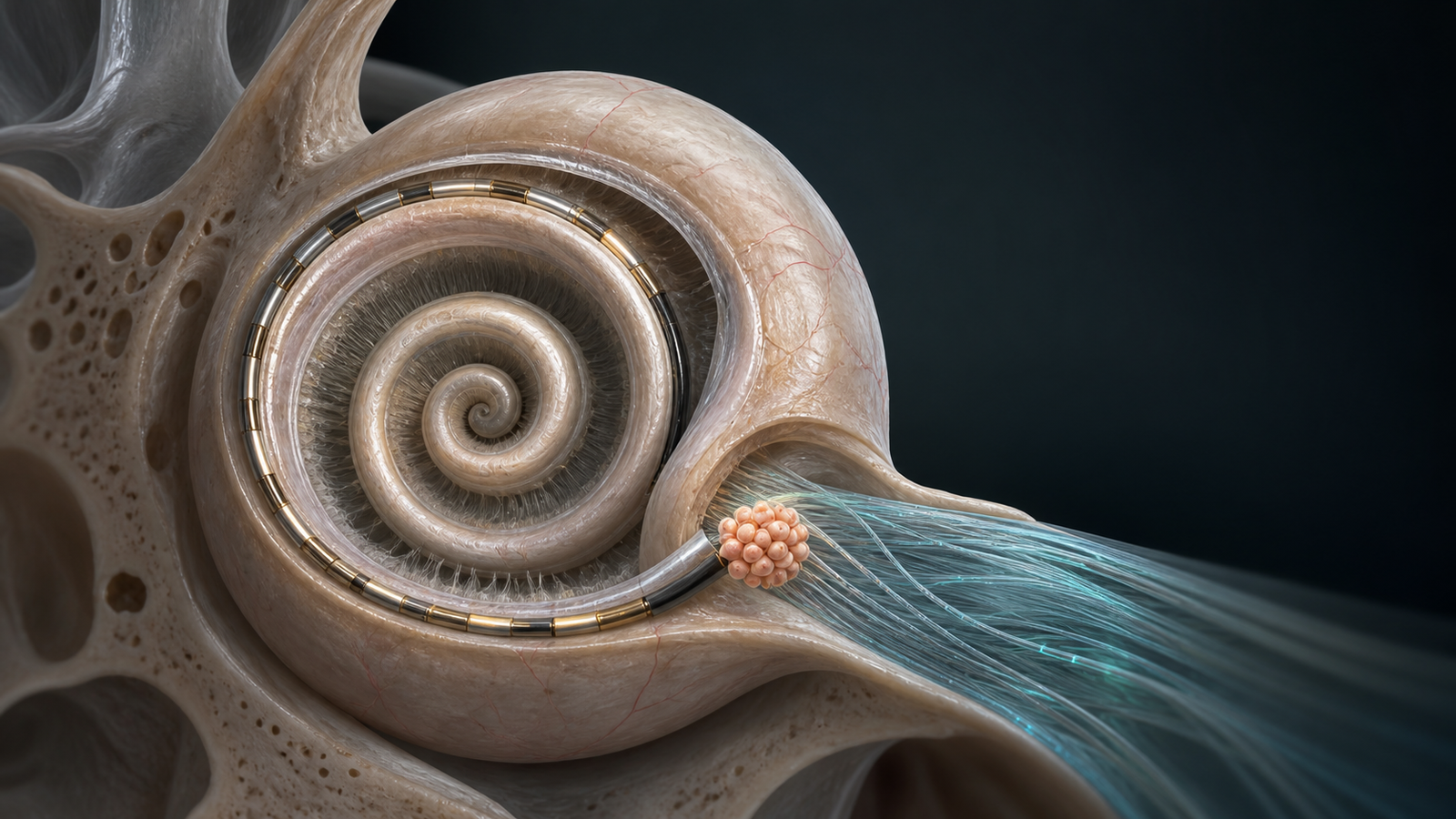
Editorial illustration of an otic neural progenitor-cell concept delivered beside a cochlear implant electrode array. Credit: CellXperience generated editorial illustration.
Rincell-1 enters the clinic through a door most cell therapies do not use: an existing cochlear-implant operation.
Many regenerative-medicine programs begin as a separate intervention. Inject the product, transplant the cells, follow the patient, then try to decide whether the biology changed. Rinri's first human trial uses a different setup. Adults already eligible for cochlear implantation are randomized to receive the implant alone or the implant plus a single dose of otic neural progenitor cells.
The design is worth reading before any result appears.
The first question is narrow, but serious: can a neural progenitor-cell product be added to cochlear-implant surgery, followed closely, and read with measures that say something useful about auditory-nerve health?
Primary sources
- ClinicalTrials.gov NCT07032038, "First In Human Randomised Trial of Rincell-1 in Adults With a Cochlear Implant" - https://clinicaltrials.gov/study/NCT07032038
- UK Health Research Authority summary, "R1-25: The First in Human Trial of Rincell-1" - https://www.hra.nhs.uk/planning-and-improving-research/application-summaries/research-summaries/r1-25-the-first-in-human-trial-of-rincell-1/
- Rinri Therapeutics press release on UK MHRA approval - https://www.rinri-therapeutics.com/uk-mhra-approval-received-for-first-in-human-trial-of-rincell-1-a-first-in-class-regenerative-cell-therapy-for-sensorineural-hearing-loss/
- University of Sheffield summary of the MHRA approval - https://sheffield.ac.uk/news/first-human-trial-regenerative-cell-therapy-sensorineural-hearing-loss-approved
The device makes the trial more readable
ClinicalTrials.gov lists the Rincell-1 study as a not-yet-recruiting Phase 1/2 randomized open-label trial with 20 estimated participants. The record was updated on August 11, 2026. The official title describes an otic neural progenitor cell-based therapy added to standard care, compared with standard care alone, in participants with presbycusis or postsynaptic auditory neuropathy who meet UK cochlear-implant guidelines.
The design is simple in the way early trials often need to be simple. One group receives routine unilateral cochlear implantation. The other receives routine unilateral cochlear implantation plus Rincell-1 during the same surgical event.
Cochlear implants already create a structured clinical workflow. The patient has a device. The device is programmed. Hearing performance is followed. In this trial, the sponsor and university summaries describe neural-health monitoring using Advanced Bionics' AIM system, alongside speech perception measures and patient-reported outcomes.
The cell therapy is being placed next to a device platform that can help generate repeated physiological measurements rather than only a before-and-after clinical impression.
Hearing loss may sit outside the usual Parkinson-stroke-retina cluster, but the central question is still neural repair. The anatomy is smaller, more accessible, and more device-linked than most brain targets.
The target is the nerve side of hearing loss
The public framing around Rincell-1 is about neural hearing loss. That distinction is important.
Cochlear implants can help many people with severe hearing loss, but their performance depends in part on the health of the auditory nerve pathway. If the limiting problem is damaged or lost auditory neurons, a device can stimulate the system only as well as the remaining neural substrate allows.
Rinri describes Rincell-1 as an otic neural progenitor-cell therapy designed to replace or regenerate damaged auditory neurons. The HRA summary describes the product in patient-facing language as specialized young auditory neurons grown in the lab, and says the first human trial will test safety and provide early information about whether cells can grow into auditory neurons in humans.
Ambitious biology deserves room when the trial language stays honest.
The important discipline is to keep the tense correct. The preclinical story motivates the human trial. The human trial has not yet shown restored hearing, durable neural replacement, or clinical benefit. What has moved forward is the ability to ask the question in people under a formal early-phase trial.
For a first-in-human regenerative program, reaching that point counts.
The added burden is part of the intervention
It would be too soft to describe this only as "cell therapy administered with a cochlear implant." The route matters.
Participants in the experimental arm are not receiving an oral drug or a brief outpatient infusion. They are undergoing cochlear implantation with an added cell-delivery step. The HRA summary says participants are followed for 52 weeks with hospital visits, health checks, blood tests, hearing tests, brain scans, and daily at-home inner-ear measurements. Participants who receive Rincell-1 take low-dose immunosuppression for ten months, and then enter long-term follow-up until 10 years after surgery.
The burden does not make the trial a bad idea. It makes the question honest.
If a cell therapy is intended to change the biology of the inner ear, it has to be judged as a procedure-plus-product intervention. The cell type, delivery method, device setting, immune management, surgical risks, and long follow-up all travel together.
The package is the intervention.
The first result should not be read like a cure story
ClinicalTrials.gov gives the study's primary outcome as frequency and severity of adverse events from baseline through 52 weeks after implantation. The registry also makes the scale clear: early, small, and first in humans.
A first-in-human trial can still teach the field a lot if the monitoring is good. Changes in auditory-neural measures, feasibility of delivery, speech perception, and patient-reported outcomes could shape the next trial, even if they do not establish clinical benefit by themselves.
The first public readout should be read in layers.
First: Was delivery feasible during cochlear-implant surgery?
Second: Were there procedure-related, device-related, immunosuppression-related, or cell-product-related safety concerns?
Third: Were the neural-health measures interpretable enough to guide the next study?
Fourth: If speech or patient-reported measures move, do they move in a way that fits the physiology and the comparator?
Early human regenerative trials earn larger studies through exactly this kind of sequence.
Why this trial is worth following
The quiet strength here is trial design.
The format is a randomized first-in-human comparison against cochlear implantation alone, with a one-year primary safety window and decade-long follow-up for treated participants. This is formal early clinical testing, not a finished-treatment claim.
The trial is also testing an idea that could matter beyond hearing loss: cell therapy may sometimes advance faster when it is integrated into an established surgical or device workflow. Retina has one version of that lesson. Parkinson cell replacement has another. Rincell-1 brings it into the inner ear.
The next threshold is straightforward. Recruitment has to open. The cell-delivery step has to work. Safety has to remain acceptable. The auditory-neural measurements have to be credible enough that a larger study can be designed around them.
If those pieces hold, the story becomes genuinely important.
The hopeful part is real, at first-human scale. A regenerative idea has reached a cochlear-implant trial. Now it has to survive contact with human surgery, immune management, device measurements, and long follow-up.