
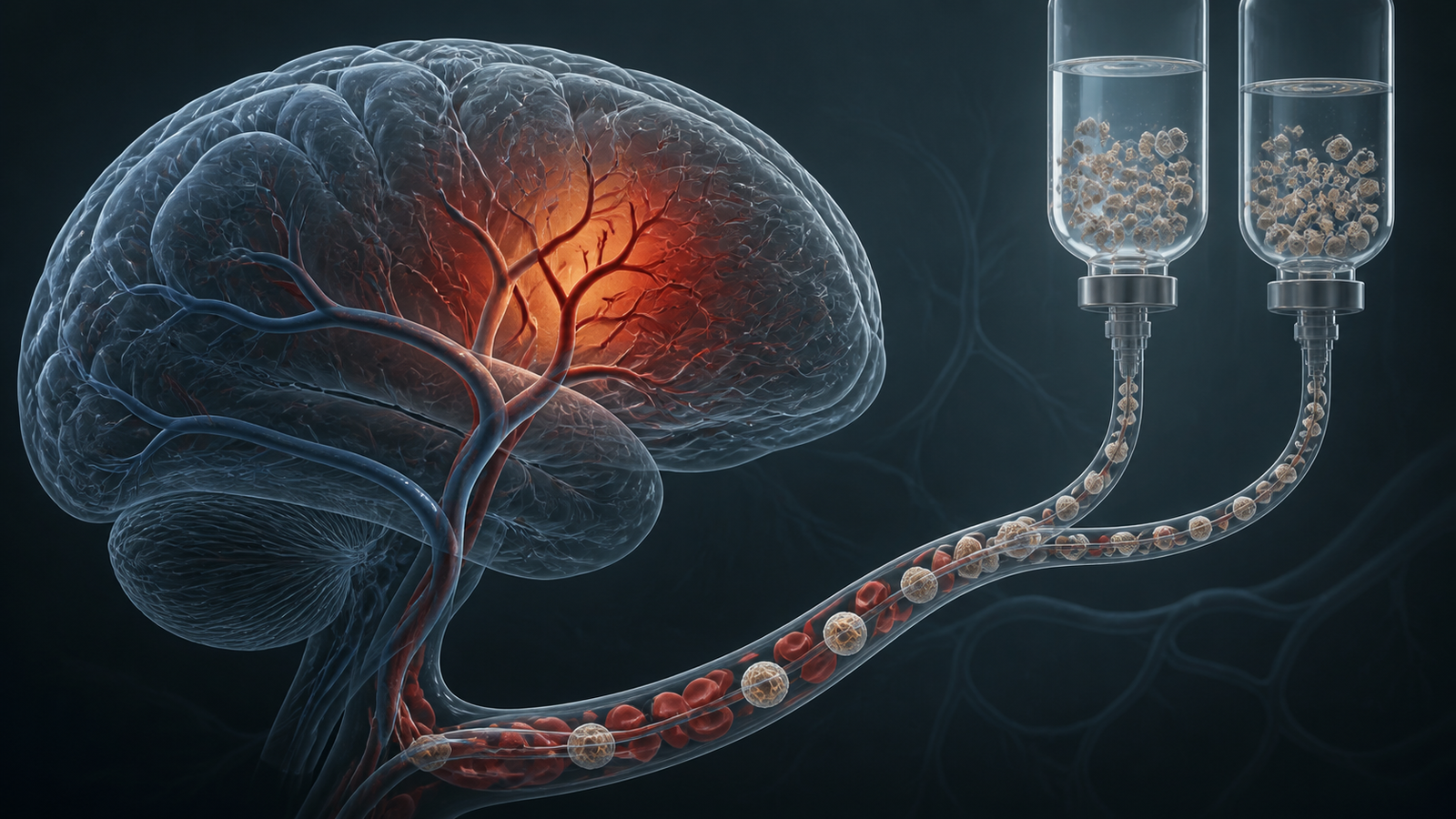
Editorial illustration of acute ischemic stroke, IV cell infusion, and matched clinical trial paths. Credit: CellXperience generated editorial illustration.
Acute stroke makes cell therapy hard to read.
A patient improves. A scan evolves. Rehabilitation begins. Swelling changes. Thrombectomy, thrombolysis, nursing care, baseline severity, timing, and biology all press on the outcome at once. Then a study asks whether an infused cell product changed the recovery curve.
Answering that question well takes more than a plausible mechanism and a recovery curve.
The new B2065 record from Tasly is useful because it accepts some of that difficulty. ClinicalTrials.gov lists a recruiting Phase 1/2a study of allogeneic adipose-derived mesenchymal stromal cell injection in acute ischemic stroke, randomized against placebo. In the same week, the MASTERS-2 Phase 3 record for MultiStem was updated as terminated.
Those two facts belong in the same field memory, not in the same basket.
B2065 is not MultiStem. An adipose-derived MSC product is not the same as a bone marrow-derived multipotent adult progenitor-cell product. A new early trial is not responsible for an older program's clinical history.
Still, MultiStem leaves the field with a serious lesson: acute stroke cell therapy cannot live on plausibility, safety, and recovery stories. It has to survive randomized comparison in a disease where timing and patient selection are brutal.
Primary sources
- ClinicalTrials.gov NCT07371624, "A Study of B2065 in Patients With Acute Ischemic Stroke" - https://clinicaltrials.gov/study/NCT07371624
- ClinicalTrials.gov NCT03545607, "MultiStem Administration for Stroke Treatment and Enhanced Recovery Study" - https://clinicaltrials.gov/study/NCT03545607
- Houkin et al., JAMA Neurology 2024, "Allogeneic Stem Cell Therapy for Acute Ischemic Stroke: The Phase 2/3 TREASURE Randomized Clinical Trial" - https://jamanetwork.com/journals/jamaneurology/fullarticle/2813591
- Athersys ischemic-stroke program page - https://www.athersys.com/multistem-therapy/clinical-trials/ischemic-stroke/default.aspx
The B2065 record is doing first-job work
ClinicalTrials.gov lists B2065 as a recruiting Phase 1/2a randomized, double-blind, placebo-controlled trial. The sponsor is Tasly Pharmaceutical Group. The record was updated on August 13, 2026, and the estimated enrollment is 54 participants.
The intervention is a single intravenous dose of allogeneic adipose-derived mesenchymal stromal cells during hospitalization. The Phase 1 dose-escalation portion includes 5.0 x 10^7 cells, 1.5 x 10^8 cells, and 4.5 x 10^8 cells, formulated in human serum albumin and sodium chloride injection. The placebo is matched by volume and number of bags.
The Phase 2a expansion then selects one or two dose cohorts from Phase 1 and randomizes participants 2:1 to B2065 or placebo.
This is still an early study. The primary outcomes are safety-heavy: dose-limiting toxicities within 28 days, infusion-related reactions, mortality, treatment-emergent adverse events, abnormal imaging findings that could suggest tumorigenicity, and tumor-marker changes through longer follow-up windows.
The first job is safety and dose behavior. Before anyone argues about functional recovery, the field needs to know whether the product can be dosed, whether infusion reactions appear, whether mortality or serious adverse events diverge, and whether longer safety monitoring stays clean.
MultiStem is the reference point nobody can ignore
The MASTERS-2 registry record is now listed as terminated. It describes a Phase 3 randomized, quadruple-masked, placebo-controlled trial of MultiStem in adults with acute ischemic stroke treated 18 to 36 hours after symptom onset. The actual enrollment is listed as 206 participants, and the primary outcome is modified Rankin Scale shift analysis at 90 days.
The registry page itself does not explain the termination.
The broader public context comes from TREASURE, the Japanese Phase 2/3 randomized trial of HLCM051/MultiStem published in JAMA Neurology in 2024. TREASURE enrolled 206 participants and tested intravenous MultiStem within 18 to 36 hours of ischemic stroke onset. The paper reported a reassuring safety profile, including no grade 3 or 4 allergic reactions, but no improvement in short-term 90-day outcomes compared with placebo.
The result still stings. It did not kill cell therapy in stroke, and the authors discuss exploratory subgroups where specific patients may still matter. The main 90-day result simply did not carry the efficacy claim the field wanted.
For a therapy class, that kind of result changes the burden of persuasion.
B2065 is not guilty by association
It would be scientifically lazy to flatten B2065, MultiStem, and every other IV cell product into one basket.
The products differ. The cell sources differ. Manufacturing differs. Potency logic may differ. Dose and formulation differ. The B2065 record uses adipose-derived MSCs; TREASURE used MultiStem/HLCM051, described in the paper as a bone marrow-derived allogeneic multipotent adult progenitor-cell product.
Those differences matter.
But acute stroke does not care about branding. It cares about whether the intervention arrives at the right biological moment, in the right patient, with a route and dose that produce enough effect to move clinical outcome beyond background recovery.
The B2065 placebo comparator is not a formality. It is the only way the program can start separating a cell-product effect from the ordinary mess of acute-stroke recovery.
The matched placebo also matters practically. If the placebo has the same volume and bag count, then the trial is doing more than comparing "treated" against "not treated." It is trying to preserve enough similarity in the hospital experience that later outcome assessments have a chance to be interpretable.
The IV route is both attractive and unforgiving
Intravenous delivery is the appealing route for acute stroke. It avoids brain surgery. It fits hospital care. It can be given within a time window that might matter for inflammation, vascular injury, immune response, and secondary repair biology.
The convenience is real.
It also creates a hard biological question. If the cells are not placed directly into the injured brain, the clinical effect has to come through systemic, vascular, immune, trophic, or repair-environment mechanisms strong enough to matter at the patient level.
In a small early trial, that effect may be hard to see cleanly. In a larger trial, it has to survive heterogeneity in stroke severity, infarct location, reperfusion treatment, age, baseline function, rehabilitation, and missing follow-up data.
This is where MultiStem remains instructive. TREASURE was not a casual uncontrolled experiment. It was multicenter, double-blind, parallel-group, placebo-controlled, and randomized. It still did not show improved short-term 90-day outcomes in the overall trial population.
The lesson is sharper than caution: design as if the disease will punish every loose assumption.
What would make B2065 useful
For B2065, the first meaningful public update does not have to be dramatic.
A clean early safety profile would matter. Dose escalation without a troubling infusion pattern would matter. Longer follow-up without tumorigenicity concerns would matter. A dose that can reasonably move into Phase 2a would matter.
If functional outcomes are reported, they should be read with unusual care. A hint on modified Rankin Scale, NIHSS, Barthel Index, Fugl-Meyer, or imaging can help choose a next study, but it should not be treated as proof of clinical benefit from a small early program.
The stronger result would be boring in the right way: safety acceptable, dose chosen, placebo comparison preserved, follow-up complete, and functional measures coherent enough to justify a larger trial without pretending the question is already answered.
That may sound modest. In acute stroke, modest is often the honest path to something useful.
The field needs both ambition and memory
There is a real reason to keep testing cell therapies in stroke. The clinical need is enormous. Acute ischemic stroke still leaves many patients with disability even after modern reperfusion care. A therapy that could safely improve recovery biology would matter.
But the field has memory now.
It has seen plausible mechanisms. It has seen early studies. It has seen safety arguments. It has seen large randomized testing fail to deliver the short-term outcome improvement many hoped for.
That memory should not make the next trial timid. It should make it sharper.
B2065 is worth following because it puts a defined allogeneic adipose-derived MSC product into a randomized placebo-controlled early trial with dose escalation and long safety follow-up. MultiStem is worth remembering because it shows how high the bar becomes when the question moves from "can we give the cells?" to "did the patient recover better because of them?"
The next good stroke cell-therapy result will need both parts: the courage to test a serious regenerative idea, and the discipline to let the comparator answer back.